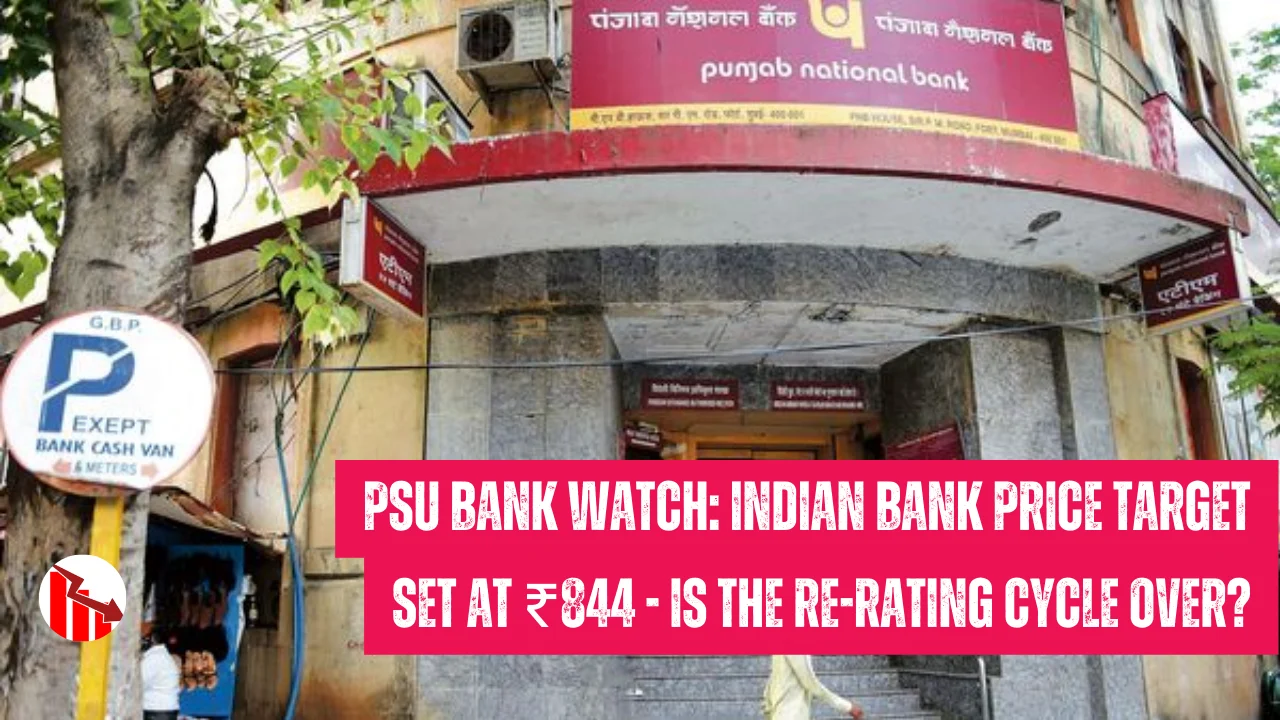
PSU Bank Watch: Indian Bank Price Target Set at ₹844 - Is the Re-rating Cycle Over?
Indian Bank price target debate has picked up momentum after analysts set a consensus target of ₹844. This comes at a time when PSU bank stocks recently witnessed sharp corrections. The stock that delivered 57 percent returns year to date now trades around ₹810 to ₹830 levels.
Recent government clarifications on FDI limits sent shockwaves across the sector. Indian Bank dropped 6 percent in a single session while the Nifty PSU Bank index tumbled over 3 percent. The bigger question now is whether the multi year re rating cycle for public sector banks has finally run its course or if there is still room for growth ahead.
Also Read: Defense Bonanza: BDL Lands Massive ₹2,461 Cr Missile Order – Should You Buy This Stock Now?
PSU bank stocks came under severe pressure on December 3 after Minister of State for Finance Pankaj Chaudhary clarified that no proposal exists to increase foreign direct investment limits in public sector banks.
The current FDI cap stands at 20 percent for PSU banks versus 74 percent for private lenders. Market participants had been speculating about a possible hike to 49 percent based on earlier reports. This speculation had fueled a strong rally in PSU banking stocks throughout September and October. When the government denied these plans the sentiment reversed quickly.
Indian Bank which was the worst hit fell 6.14 percent in a single session. Punjab National Bank declined nearly 4 percent while Bank of India dropped over 3 percent. The Nifty PSU Bank index slipped 3.04 percent reflecting broad weakness across all 12 constituents.
The selloff marked the second consecutive session of decline for PSU banks. A day earlier the minister had also ruled out any immediate merger or consolidation plans among state owned lenders. These back to back clarifications removed two major catalysts that investors were banking on for further upside.
Market experts noted that the correction was a natural profit booking move after the sector had rallied sharply for several months. The FDI limit clarification particularly disappointed those who expected easier capital raising options for PSU banks without diluting government stakes significantly.
Despite the recent selloff Indian Bank fundamentals continue to shine. The bank reported Q2 FY26 results that showed net profit jumping 24 percent year on year to ₹2300 crore. Net interest income grew 15 percent to ₹7200 crore with net interest margin expanding to 3.45 percent. This represents a 10 basis points improvement on a quarterly basis.
The advance book grew 12 percent year on year reaching ₹5.8 lakh crore driven primarily by retail and MSME segments. This growth rate outpaces the banking sector average of 10 percent. Deposit growth also remained healthy at 11 percent taking the total to ₹6.2 lakh crore. The CASA ratio stayed stable at 42 percent supporting healthy margins.
Asset quality metrics tell an even more impressive story. Gross NPA has fallen to 3.09 percent which is the lowest level in 10 years. Net NPA stands at just 0.19 percent showing strong recovery in the legacy loan book.
Credit cost has been contained at 0.25 percent as slippages remain low. Provisions have declined 20 percent due to better asset quality. Return on assets reached 1.1 percent while return on equity touched 17 percent matching private sector benchmarks. The bank market cap has grown 19.6 times since FY20 lows now standing at approximately ₹72000 crore. Employee productivity improved to ₹20.6 crore per head benefiting from digital transformation and operational efficiencies.
Indian Bank has made significant strides in digital adoption which sets it apart from many PSU peers. The bank now processes 94 percent of its transactions through digital channels. This is a remarkable achievement for a public sector lender with a vast branch network of 5901 branches across the country.
The shift to digital has helped reduce operating costs with the opex to assets ratio falling to 2.4 percent. The bank has strategically focused on non branch channels for retail loan growth. Retail loans grew 26 percent through fintech partnerships and digital platforms.
This approach allows the bank to expand its reach without the heavy cost of physical infrastructure. The bank ISO 27001 certified digital operations provide confidence in security standards.
Post its 2020 merger with Allahabad Bank the combined entity has been able to leverage scale advantages. The integration has been smooth allowing the bank to rationalize operations and reduce redundancies.
Management projects advance growth of 11 to 12 percent CAGR through FY27 supported by the digital infrastructure and expanding customer base. The focus on MSME and retail segments provides diversification away from large corporate exposures. Vehicle loan demand recovery and strategic cost optimization initiatives are expected to drive consistent quarterly improvements going forward.
The ₹844 price target set by analyst consensus represents an interesting inflection point for investors. With the stock currently trading around ₹810 to ₹830 this target implies a modest downside of 2 to 4 percent. This has led many market observers to question whether the re rating story for PSU banks is nearing exhaustion. However context is important here.
PSU banks still trade at significant discounts to private sector peers. Indian Bank trades at 0.8 to 1 times price to book value. Compare this to HDFC Bank or ICICI Bank which trade at 2.5 to 2.7 times book value. This valuation gap exists despite Indian Bank now delivering return on equity of 17 percent which is competitive with private banks.
Different analysts have varying views on the future trajectory. Motilal Oswal maintains a buy rating but sets a conservative target of ₹750 representing 8 percent downside. ICICI Direct is more bullish with a target of ₹930 citing digital efficiency and undervaluation.
TradingView analysts project a neutral stance with ₹860 target and a maximum upside scenario of ₹930. WalletInvestor forecasts ₹854 for the short term but projects ₹1439 by 2030 in its long term view. The bull case for further re rating hinges on triggers like merger announcements or FDI limit hikes materializing.
If the government changes stance and allows 49 percent FDI the stock could potentially reach ₹950 plus levels at 1.2 times book value. The bear case factors in margin pressure from potential rate cuts and FII outflows which could pull the stock down to ₹700 levels.
The short answer is no but the nature of gains is evolving. PSU banks have undergone a dramatic transformation since FY20. Gross NPAs across the sector have fallen 69 percent while profitability hit record levels of ₹1.8 trillion in FY25.
Indian Bank exemplifies this turnaround with its stock price rising 1500 percent from ₹55 in November 2020 to ₹874 in November 2025. This represents a 75 percent CAGR over five years. The re rating has been justified by fundamentals rather than speculation.
The banks have cleaned up their balance sheets improved governance and embraced technology. They now deliver returns comparable to private banks at half the valuation multiples.
What is changing is that the easy gains are behind us. The sector has already re rated from deeply distressed valuations to reasonable levels.
Further upside will likely be more gradual and tied to earnings growth rather than multiple expansion. Analysts project 13 to 14 percent earnings growth for FY26 which would support stock price appreciation in the low to mid teens percentage range. The upcoming rate cut cycle could provide a tailwind. PSU banks have higher exposure to MCLR linked loans compared to private banks.
As these loans reprice with lower rates net interest margins could see some expansion. Capex revival in the economy would also benefit PSU banks given their larger exposure to infrastructure and project financing.
Social media sentiment on platform X shows retail investors remain largely optimistic. Around 70 percent of recent posts express bullish views on PSU banks fundamentals. Users praise Indian Bank as a silent multibagger that delivered without much market noise.
The efficiency gains and digital scale are frequently highlighted. However there is also caution about near term momentum. About 30 percent of posts question whether the cycle has peaked after the recent 30 percent index surge.
The dashed merger and FDI hopes have tempered enthusiasm. Most active traders suggest waiting for dips to ₹780 levels before adding positions. The target of ₹940 is seen as achievable over 12 to 18 months rather than immediate.
For existing investors holding Indian Bank there is no compelling reason to exit based purely on the ₹844 target. The fundamentals remain solid and the valuation discount to private peers provides a margin of safety.
The dividend yield of 1.2 percent offers some income while you wait for capital appreciation. For new investors looking to enter the key is patience. The recent 6 percent correction provides a better entry point than prevailing prices two weeks ago.
Technical support exists around ₹780 which coincides with the 50 day exponential moving average. Buying on dips to this level could offer a favorable risk reward setup. Resistance is likely around ₹890 which was the recent high.
The broader PSU banking space still offers tactical upside according to JPMorgan strategist Rajiv Batra. While the dramatic re rating phase may be complete steady earnings growth should support gradual appreciation.
Investors should focus on banks that have demonstrated consistent execution like Indian Bank rather than chasing speculative merger plays. The midcap PSU banks are justified in trading at a premium to larger peers given their superior return ratios and growth profiles.
Rate cut expectations remain a key variable to watch. If the RBI signals an accommodative stance in December the sector could see renewed interest from FII investors who have been cautious recently.
A portfolio allocation of 10 to 15 percent to PSU banks makes sense for investors with moderate risk appetite. Indian Bank specifically offers a good balance of safety and growth potential. The stock has support from both fundamental and technical factors.
The re rating story is not over it is simply entering a new phase where patience and selectivity will matter more than momentum chasing.
Tags: Indian Bank, PSU banks, price target, re-rating cycle, bank stocks, FDI limits, asset quality







Share This Post