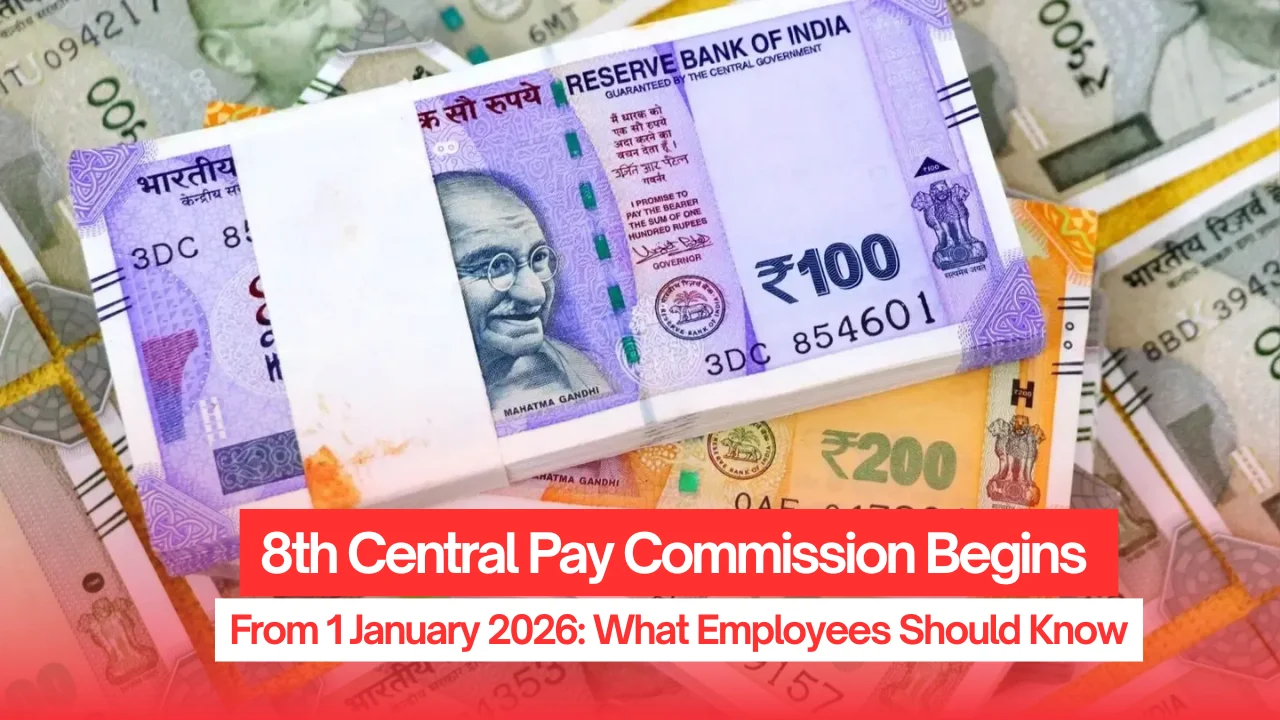
8th Central Pay Commission Begins From 1 January 2026: What Employees Should Know | Image With UpStox
Central government employees and pensioners have now entered a new phase of pay revision with the 8th Central Pay Commission taking effect from 1 January 2026. This marks the formal end of the 7th Pay Commission cycle that ran for ten full years.
The Union Cabinet had already approved the formation and Terms of Reference of the panel in late 2025. The commission is chaired by Justice Ranjana Prakash Desai.
It will study salaries, pensions, allowances and other service conditions for more than 50 lakh central government employees and around 65 to 69 lakh pensioners. The panel has been given 18 months to submit its report.
This means that the final salary announcement is likely only in late 2027 or early 2028. Employees will receive arrears from 1 January 2026.
Also Read: Modern Diagnostic IPO GMP Today: Premium Rises With Strong Subscription Demand
Government employees will not see an instant rise in their January salary. The 7th Pay Commission pay structure will continue for now.
Only regular Dearness Allowance revisions will take place in the meantime. Based on current data trends, the next DA revision could be close to 2 percent, subject to official calculation.
At the state level, Assam has already moved ahead by setting up its own State Pay Commission.This has increased interest and expectations among employees across the country.
The most important part of the salary revision is the fitment factor. This multiplier converts the present basic pay into the revised 8th CPC basic pay. In earlier commissions, the factor was 1.86 to 1.92 under the 6th CPC and 2.57 under the 7th CPC.
Forecasts for the 8th CPC fitment factor suggest three broad possibilities:
Under these projections, the minimum basic pay of ₹18,000 may rise toward ₹33,000 to ₹51,000 or more. After the revision, DA will reset to 0 percent, then increase again every six months. House Rent Allowance, Travel Allowance and other payouts will also be revised.
Entry level employees such as Level 1 staff may see take home income cross ₹50,000 to ₹60,000 per month including allowances. Senior officers may see basic pay above ₹2 to ₹3 lakh. The percentage rise often benefits junior employees more in relative terms.
Reactions on social media show mixed opinions. Many employees and unions see this as long awaited relief after rising prices over the past decade. Some have also demanded interim relief, DA merger and higher fitment.
At the same time, private sector voices raise concerns about the tax burden and pay gap between sectors. A number of users highlight that entry level government salaries already start near ₹40,000 to ₹55,000, which is more than many private jobs.
There is also a larger debate on whether the pay hike will help boost consumption or place pressure on public finances. For many supporters, the strong attraction of a government job remains stability, pensions, and long term security. Critics continue to question productivity reform and cost to taxpayers.
Although the effective date is 1 January 2026, the final salary rollout may happen only after the commission submits its report. This is expected in 2027 or 2028. Employees will then receive arrears covering the full period. For example, if the revised salary increases from ₹45,000 to ₹50,000, the ₹5,000 difference per month becomes the arrear component. The amount will also be taxable under income tax rules.
This is not new. Under the 7th Pay Commission, revised salaries came in mid-2016 but arrears were paid from January 2016.
Assam has become the first state to constitute its own 8th State Pay Commission. The government has appointed former chief secretary Subhas Das to head the panel. This may give state employees an early advantage if the process concludes quickly. Economists expect that, even after formation, the final decision process will still take time.
The commission now has the responsibility to balance fiscal limits and employee welfare. Employees expect clarity on pay matrices, grade-wise increments and pension structures. The government is likely to assess economic growth, inflation data and revenue conditions before final implementation. For now, Dearness Allowance remains the only moving salary component till the final report.
Tags: 8th Pay Commission, Central Government Employees, Salary Revision, Fitment Factor, Arrears, DA Hike, Pension Revision, Pay Matrix






Share This Post