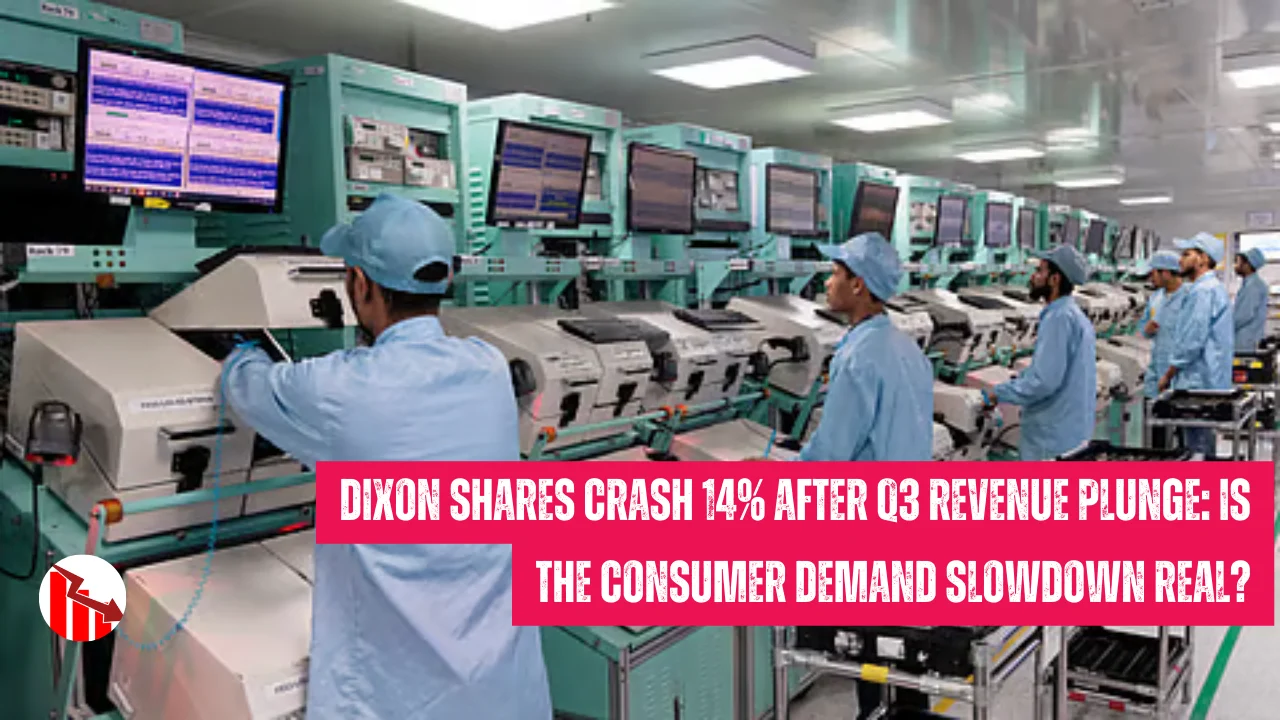
Dixon Shares Crash 14% After Q3 Revenue Plunge: Is the Consumer Demand Slowdown Real?
Dixon shares crash has sent shockwaves through the Indian stock market as the electronics manufacturing giant witnessed its worst single day drop in nearly two years. On January 21 2025 Dixon Technologies stock plummeted 14 percent wiping out almost 20000 crore from its market capitalization.
The sharp decline came just a day after the company reported its Q3 FY25 results which showed impressive year on year growth but concerning sequential trends. Despite revenue doubling to 10454 crore the companys net profit fell 47.5 percent quarter on quarter raising serious questions about sustainability.
Investors who had enjoyed a massive 200 percent rally over 12 months were caught off guard as the stock broke below its 100 day moving average for the first time since May 2023. The crash has sparked intense debate about whether Indias consumer electronics boom is facing a real slowdown or if this is just a temporary blip in an otherwise strong growth story.
Also Read: Corona Remedies IPO Opens Dec 8 with Strong 34% Listing Gain Forecast
The dixon shares crash caught many investors by surprise because the headline numbers looked impressive at first glance. Revenue from operations more than doubled on an annual basis showing 117 percent growth.
However the devil was in the details as sequential performance told a completely different story. Net profit dropped from Rs 413 crore in Q2 to just Rs 217 crore in Q3 representing a massive 47.5 percent decline quarter on quarter. This happened because of higher depreciation costs increased interest expenses and minority interest adjustments that ate into profitability.
The mobile and EMS division which now accounts for 90 percent of total revenue showed signs of peaking according to analysts at Goldman Sachs. While this segment grew 190 percent year on year it actually declined 1.5 percent sequentially suggesting that the explosive growth phase might be coming to an end.
The companys consumer electronics and appliances business suffered even more dramatically falling 32 percent annually and 58 percent quarter on quarter. This segment which once contributed 19 percent of revenue now makes up only 6 percent.
Market sentiment turned extremely negative as investors realized that Dixon was trading at stretched valuations. With a PE ratio of 106 times FY26 earnings the stock had simply run too far too fast. The 200 percent rally over the previous 12 months had created unrealistic expectations that any sign of weakness would trigger massive profit booking.
From a technical perspective the dixon shares crash represents a significant breakdown in market structure. The stock fell below its 100 day moving average at Rs 15507 for the first time since May 2023. This support level had held firm for 20 months during which the stock rallied an incredible 532 percent from its breakout point. The breach of this crucial support suggests that the long term uptrend may be under threat.
Technical indicators are flashing warning signs across the board. The RSI has dropped to 34.4 indicating oversold conditions but not yet showing signs of a reversal. The stock is trading below all its key moving averages including the 20 day 50 day and 100 day levels.
Chart analysis suggests the next major support lies at Rs 14370 where the weekly super trend line is positioned. If this level fails to hold the stock could potentially slide all the way down to its 200 day moving average at Rs 12950 representing an additional 15 percent downside from current levels.
Trading volumes surged dramatically during the crash with nearly 60000 shares changing hands on the BSE compared to the two week average of just 14000 shares. This spike in volume on a down day confirms strong selling pressure and suggests that institutional investors may be reducing their positions after the stellar run up.
The question on everyones mind is whether the dixon shares crash signals a broader slowdown in consumer electronics demand across India. The data presents a mixed picture that requires careful analysis.
Indias consumer electronics market is projected to grow from USD 89.5 billion in 2025 to USD 158.4 billion by 2034 representing a healthy compound annual growth rate of 6.56 percent. This structural growth is driven by rising middle class incomes rapid urbanization and increasing adoption of 5G and AI enabled devices.
However Q3 results revealed selective pockets of weakness that cannot be ignored. The appliances and TV segment showed significant stress with Dixon reporting a 32 percent annual decline.
Industry experts attribute this weakness to multiple factors including prolonged monsoons that delayed purchases GST rate changes that were implemented in October and inventory pile ups at the retail level. Interestingly festive season sales were initially muted but picked up sharply after the GST reductions on air conditioners and LED products.
The mobile segment tells a completely different story showing remarkable resilience with 190 percent year on year growth.
This strength is fueled by the premiumization trend as consumers increasingly opt for 5G enabled smartphones and AI powered features. Easy EMI availability has also democratized access to higher priced devices with consumer loan NPAs remaining healthy at just 1.35 percent for premium products.
Rural and tier 2 tier 3 markets are emerging as new growth engines driven by rural electrification programs and rising incomes. Summer sales of air conditioners jumped 30 percent suggesting that underlying demand fundamentals remain strong.
The government Production Linked Incentive scheme is also providing a major tailwind with subsidies worth Rs 15000 crore helping companies like Dixon expand manufacturing capacity and move up the value chain.
Brokerage houses have issued sharply divided opinions following the dixon shares crash reflecting genuine uncertainty about the companys near term prospects. Jefferies has taken the most bearish stance with an Underperform rating and a target price of just Rs 12600.
The brokerage argues that risk reward has become stretched at current valuations and that the mobile business may have already peaked in terms of growth rates.
On the other end of the spectrum Motilal Oswal maintains a Buy rating with a target price of Rs 20500 representing potential upside of about 35 percent from current levels. They have actually revised their earnings estimates upward by 7 percent for the mobile segment citing strong order books and new customer additions.
HSBC also remains positive with a Buy rating and Rs 20000 target highlighting the upcoming display fabrication facility as a major value driver that could significantly improve margins.
Nuvama has adopted a middle ground approach with a Hold rating and target price of Rs 18790. While they acknowledge the strong fundamentals and execution capabilities they have trimmed profit estimates by 3 to 10 percent for FY25 to FY27 to account for weakness in the TV segment and the impact of consolidating the Vivo joint venture. The consensus target price across all brokerages averages around Rs 18000 suggesting potential upside of 15 to 20 percent from the post crash lows.
Most analysts emphasize that Dixon long term story remains intact supported by backward integration initiatives government PLI subsidies and the massive opportunity in Indias electronics manufacturing sector. The company plans to invest in camera modules battery production and display fabrication which could boost margins from the current 3.8 percent to 4.5 to 5 percent over the next two to three years.
The dixon shares crash presents both risks and opportunities for investors depending on their time horizon and risk appetite. For short term traders the technical breakdown below key support levels suggests caution is warranted.
The stock needs to reclaim its 100 day moving average at Rs 15507 and sustain above that level before a meaningful recovery can be established. Until then the path of least resistance appears to be lower with potential support at Rs 14370 and Rs 12950.
For long term investors the crash may actually represent an attractive entry point into a structural growth story. Dixon is uniquely positioned to benefit from Indias ambitions to become a USD 300 billion electronics manufacturing hub by FY26.
The company has secured partnerships with major global brands including Xiaomi Oppo Motorola and now HP for laptop manufacturing. The new joint venture with Vivo once regulatory approvals are obtained could add significant revenue and demonstrate confidence from Chinese smartphone makers.
The key risk factors that investors need to monitor include regulatory uncertainties around the Vivo partnership given the ongoing SFIO probe into fund diversion allegations. Any negative developments on this front could trigger another leg down.
Currency volatility is another concern as a 5 percent depreciation in the rupee could increase import costs by 2 to 4 percent impacting margins. Competition is also intensifying with peers like Kaynes Technology and Avalon Technologies posting strong growth numbers.
However the positives are equally compelling. Dixon debt to equity ratio stands at just 0.06 providing ample financial flexibility for expansion.
The order book remains robust with expected 59 percent CAGR in mobiles through FY27. The company is also making strategic moves into higher margin businesses like display fabrication which could be a game changer if subsidies under ISM 2.0 materialize as expected.
Tags: dixon technologies stock crash, dixon shares crash, Q3 results 2025, consumer electronics India, mobile manufacturing EMS, stock market crash, valuation concerns







Share This Post