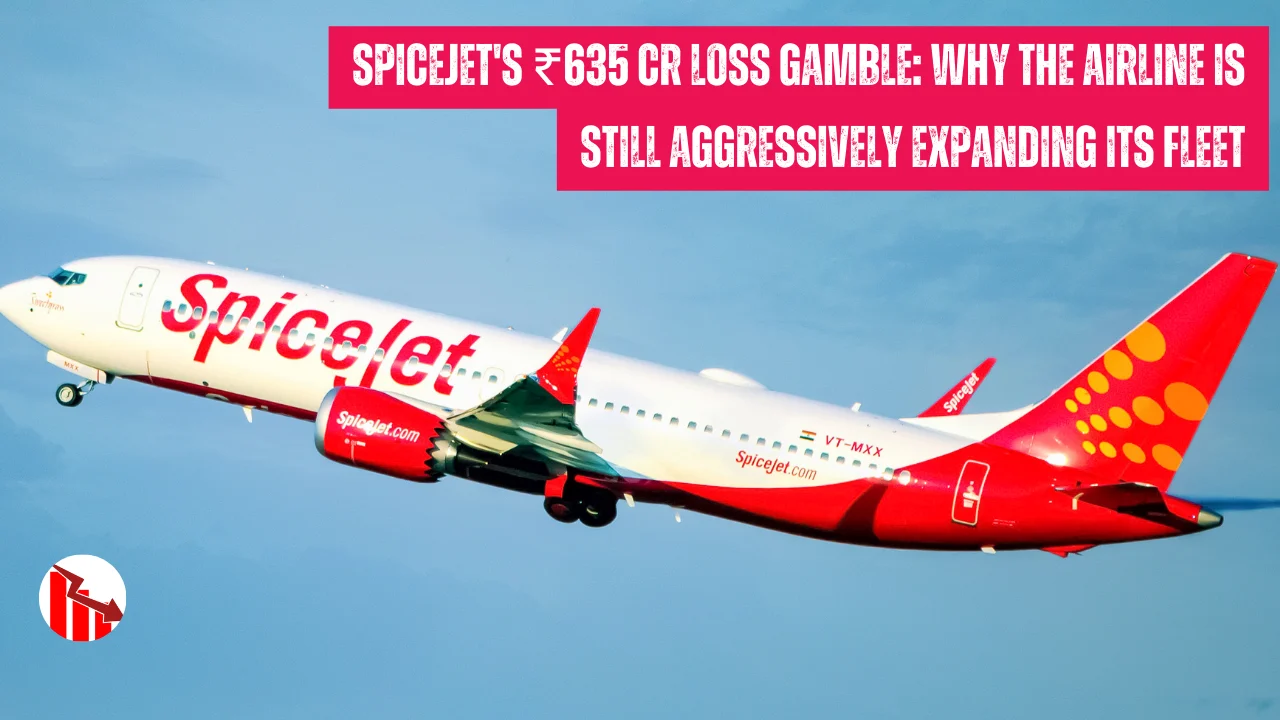
SpiceJet's ₹635 Cr Loss Gamble: Why the Airline is Still Aggressively Expanding its Fleet
SpiceJet reported a massive loss in Q2 FY26 but the airline is not stopping. The company posted a net loss of 635 crore rupees which is 42 percent more than last year. Despite these heavy losses the airline is adding more planes and expanding operations.
Many people are confused about this strategy. Why would a company losing money spend more on growth.
This is not the first time an Indian airline has taken such a big risk. The aviation industry in India has seen many airlines shut down after expanding too fast. But SpiceJet believes this gamble will pay off. The company is betting on India’s growing aviation market.
Chairman Ajay Singh says these losses are short term costs for long term gains. The airline expects to turn profitable by FY27.
Investors and analysts are watching closely to see if this bold strategy works. The airline industry is tough and competition is high. SpiceJet is facing challenges from grounded planes, high costs and market share loss. But the company is confident about its revival plan.
Also Read: Dixon Shares Crash 14% After Q3 Revenue Plunge: Is the Consumer Demand Slowdown Real?
SpiceJet’s financial results for the second quarter were shocking for many investors. The airline reported a consolidated net loss of 635.42 crore rupees.
This is much higher than the 447.54 crore loss in the same period last year. If we remove the forex impact the adjusted loss was 447.70 crore rupees. Revenue from operations fell 13 percent to 792 crore rupees from 915 crore rupees last year.
Total income dropped to 835 crore from 1078 crore rupees. These numbers look very bad on paper.
The main reasons for these losses are clear. SpiceJet spent 120 crore rupees on maintaining 35 grounded aircraft. These planes are not flying but still need maintenance and storage. The company also spent 30 crore rupees on bringing two grounded planes back to service.
Foreign exchange losses made things worse. The rupee depreciation increased dollar denominated lease costs. India Pakistan airspace closure added more expenses. The airline lost 236 crore rupees in one quarter due to longer flight routes. EBITDAR loss widened to 204 crore from 59 crore last year.
But not everything is bad news. The airline’s operational metrics show some strength. Passenger Load Factor stayed at 84.3 percent which is above industry average. This means planes are flying with good occupancy.
Passenger Revenue per Available Seat Kilometre improved to 4.04 rupees from 3.91 rupees. This shows better pricing power and strong demand. Market share has fallen to 1.9 percent from 3.2 percent earlier in 2025. The company’s accumulated losses now total 8692 crore rupees with negative net worth at 2801 crore rupees.
The big question everyone is asking is why expand when losing money. SpiceJet’s strategy is based on a simple idea. The Indian aviation market is growing very fast. Daily passengers are expected to cross 5 lakh by end of 2025.
The airline wants to grab market share before it is too late. In Q2 the company finalized damp leases for 19 aircraft. It also brought back two Boeing 737s into service. The active fleet increased from 19 planes to 30 to 32 by December 2025.
SpiceJet plans to more than double its fleet to 68 aircraft from 54 planes. This will triple Available Seat Kilometres from 55 crore to 110 crore. Daily flights will increase from 176 to over 250 flights. In November 2025 five more Boeing 737s were added including one MAX aircraft.
The focus is on domestic routes and regional expansion. The airline is also exploring widebody planes for international growth. New routes include direct flights to Najaf in Iraq and Kathmandu. During Haj operations the airline successfully carried 15500 pilgrims.
This expansion is timed for peak winter demand and festive travel season. The airline has signed interline agreements with partners like Gulf Air. Liquidity has improved with 89.5 million dollars from Carlyle Aviation settlements.
Another 24 million dollars came from Credit Suisse repayment. Credit ratings have been upgraded with Acuite giving BB Stable rating. CRISIL upgraded the rating to A4 plus. Debt has come down significantly from 8000 crore to 5000 crore through restructuring. In November 2025 alone the company eliminated 442 crore rupees of debt.
Public opinion about SpiceJet’s strategy is divided. Around 60 percent of posts on X express doubt about the airline’s future. Many users remember the collapse of Kingfisher in 2012 and Jet Airways in 2019. GoFirst shut down in 2023 after expanding too fast.
People are worried SpiceJet might follow the same path. Comments like “SpiceJet expanded beyond capacity now dying like others” are common. Political debates also come up with opposition voices blaming government favoritism toward IndiGo which has 65 percent market share.
But there is also optimism among some people. When IndiGo faced massive disruptions in December 2025 due to pilot rest rules SpiceJet benefited. The airline added 100 extra flights on December 5 and 6. SpiceJet’s stock jumped 6 to 7 percent during this time.
One traveler shared a surprisingly good experience on a Goa flight that arrived 7 minutes early. This was linked to the airline’s 26 crore profit in Q3 FY25. Analyst meetings in December 2025 created buzz about sharp scale up plans.
A promotional post by SpiceJet about extra flights got 3400 likes and 294 reposts. Users are comparing today’s airline duopoly with pre 2014 diversity when SpiceJet had 18 percent share. Some admire the airline’s resilience pointing out zero DGCA safety findings for over one year.
Searches for “SpiceJet alternatives to IndiGo” have increased. People are frustrated with high ATF taxes which went up 60 percent despite global fuel price drops. Overall sentiment is cautious admiration mixed with concern about sector volatility.
SpiceJet shares have been very volatile this year. The stock is down 45 percent year to date but rose 7 percent on December 5 and 6 2025. Foreign Institutional Investors have tripled their holdings to 25 percent with Goldman Sachs buying in.
Domestic Institutional Investors have also increased stakes while public holding has decreased. Plutus Wealth added 2.34 percent stake worth around 200 crore rupees in October 2024 at 46 rupees per share. This shows institutional confidence in the turnaround story.
Operational performance has been good with zero Level 1 DGCA findings for over a year. Network expansion to Middle East and South Asia is progressing well. The successful Haj operations and festive capacity addition show demand is coming back.
The aviation industry is growing with passenger traffic hitting 5 lakh per day from just 50000 in 2013. But challenges remain. Even IndiGo posted a 2600 crore loss in Q2 showing sector wide pressures. Supply chain delays and engine shortages are affecting all airlines. Boeing MAX groundings hit the entire industry.
Analyst calls in December 2025 project FY27 profitability through cost controls. Revenue initiatives like ancillary sales are increasing with a new VP hire. Short term stock targets are around 200 rupees with stop loss at 40 rupees.
Long term targets go up to 1000 rupees plus based on India’s aviation boom. The airline is focusing on low cost carrier model with regional routes. The widebody push for international routes could open new revenue streams. Investor sentiment is improving but execution will be key to success.
Tags: SpiceJet loss, airline fleet expansion, Indian aviation industry, SpiceJet Q2 results, airline turnaround strategy, aviation sector India, SpiceJet stock analysis






Share This Post