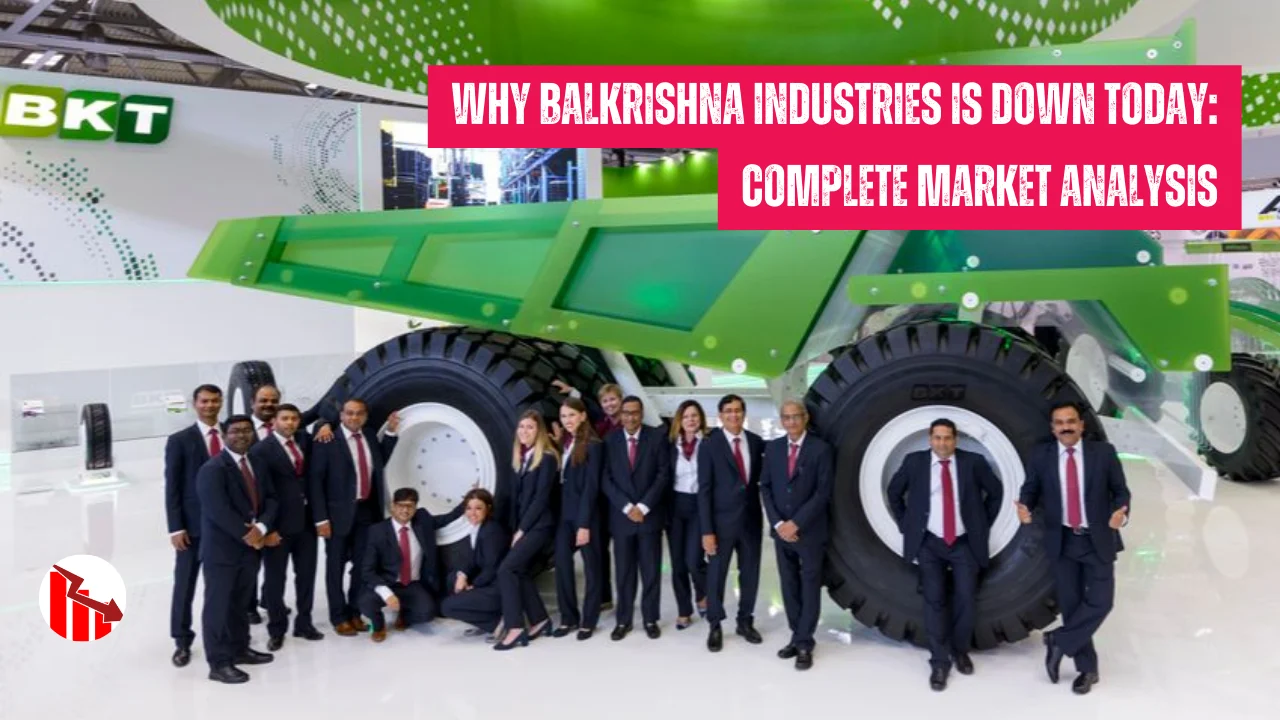
Why Balkrishna Industries is Down Today: Complete Market Analysis
Why Balkrishna Industries is down today is the question on every investor’s mind as the stock declined by approximately 1.5 to 2 percent in early trading on December 9, 2025.
The tire manufacturing giant saw its share price drop to around Rs 2,520 to Rs 2,550 from the previous close of Rs 2,580. This decline continues a broader bearish trend that has plagued the stock throughout 2025.
Balkrishna Industries Ltd operates as a leading manufacturer of off highway tires for agricultural construction mining and specialized applications. The company has underperformed significantly with over 15 percent drop year to date while the BSE Auto index gained 2.12 percent during the same period.
The current market conditions paint a challenging picture for export oriented companies like Balkrishna Industries. With approximately 90 percent of its revenue coming from international markets, the company faces multiple headwinds.
Foreign institutional investors remain sidelined due to nominal GDP growth in single digits and negative wholesale price index numbers. These macroeconomic factors combined with sector specific challenges have created sustained pressure on the stock price.
Also Read: Why Hyundai Motor is Down Today: Market Pressure and Global Concerns Hit Stock
The broader market weakness played a significant role in today’s decline. Indian equities experienced profit taking and risk off sentiment across the board. Investors shifted away from mid cap stocks like Balkrishna Industries toward large cap names.
This rotation happened amid fears of delayed India US trade deals and rising tariffs impacting export earnings. The BSE Consumer Durables index fell 1 percent dragging down peers in industrial applications.
Mid cap stocks particularly suffered with many hitting fresh 52 week lows in the BSE 500 list. The BSE SmallCap Index fell below its 100 day moving average for the first time since May.
Export heavy stocks bore the brunt of selling pressure as foreign institutional investors continued their retreat. The broader market showed Sensex up 0.77 percent at 82,348 but small and mid cap indices faced sustained pressure.
The lingering impact from May 2025 earnings continues to haunt the stock. Balkrishna Industries reported Q4 FY25 results that showed a sharp 25 percent year on year drop in standalone net profit to Rs 362 crore.
The company missed analyst estimates due to one time forex losses higher input costs employee expenses and finance costs. Tire volumes remained flat at 82,062 tonnes showing no growth momentum.
Revenue grew modestly by 2.8 percent year on year to Rs 2,747 crore but EBITDA margins contracted to 21.9 percent from 25.1 percent previous year. This triggered an immediate 10 percent plunge on May 26 2025 and the stock never fully recovered.
Currently trading 17 percent below its 52 week high the company faces persistent demand headwinds in key global markets like Europe and North America.
| Metric | Q4 FY25 | Q4 FY24 | YoY Change |
|---|---|---|---|
| Revenue | Rs 2,747 Cr | Rs 2,672 Cr | +2.8% |
| Net Profit | Rs 362 Cr | Rs 485 Cr | -25.4% |
| EBITDA Margin | 21.9% | 25.1% | -3.2 pts |
| Volume | 82,062 Tonnes | 82,062 Tonnes | Flat |
Major brokerages downgraded their stance on Balkrishna Industries post Q4 results. Motilal Oswal assigned a Neutral rating with target price of Rs 2,257.
Nomura downgraded to Neutral while Citi maintained Sell rating with Rs 2,400 target. These analysts cut earnings estimates by 8 to 10 percent for FY26 27 citing demand uncertainty and diversification risks.
The company plans to enter premium passenger car radial and truck bus radial tire segments. This expansion involves a new 35,000 tonne facility at Bhuj operational by end FY26. Total capacity will ramp to 4.25 lakh tonnes requiring significant capital expenditure.
Analysts view this diversification as potentially dilutive to return on equity in short term. Motilal Oswal specifically called success in these competitive segments a herculean task requiring completely different sales and distribution strategies from core off highway tire business.
The weak Indian rupee emerged as one of Asia’s weakest currencies amplifying forex losses for export focused firms.
Rising US tariffs threaten export earnings with Q3 FY26 estimates already factoring substantial impacts. Commodity volatility in raw materials like rubber and carbon black continues to pressure margins. The company faces limited pricing power amid stiff global competition.
Projected EBITDA margins stand at 26.2 percent by FY27 up from current levels but still below pre 2025 peaks. The valuation appears stretched with stock trading at 29.8x FY25 earnings above sector average of 25x. Price to book ratio stands at 4.74x raising concerns about premium valuation given the challenging earnings trajectory.
Social media discussions reveal investor frustration with the stock’s underperformance. Users highlight clear downtrend and broken support levels below Rs 2,600. Many advise against holding the stock for 2 to 3 years given current market conditions.
Blame falls on foreign institutional investor and domestic institutional investor selling margin trading facility liquidations and negative commentary from market analysts.
Sparse mentions exist of past governance issues but no fresh red flags emerged. Sentiment remains neutral to negative with low engagement on Balkrishna specific posts compared to peers like Ceat.
Some long term investors still admire the company’s strong franchise and low cost operations. However worries dominate regarding expansion risks and export vulnerabilities with no viral positivity observed today.
Short term outlook suggests continued volatility with support at Rs 2,400 analyst downside target and resistance at Rs 2,700. A breakthrough in trade deal negotiations or Q3 volume pickup could stabilize the stock.
Long term analysts project 9 percent volume compound annual growth rate through FY27 but success in passenger car radial and truck bus radial diversification remains pivotal.
Investors currently holding should monitor the December 3 BSE query response on volumes. The company cited market driven factors with no unpublished price sensitive information.
For new entry waiting for stabilization below Rs 2,500 makes sense given current bearish sentiment. The stock could offer dip buying opportunity if macroeconomic conditions improve and global demand recovers in key export markets.


Share This Post